STEM Education Technology Trends 2026: Are EdTech & STEM Certifications Worth It? Job Outlook, Salary & Career Guide
Evaluating EdTech and STEM credentials requires looking beyond software vendor marketing to understand their actual impact on hiring and classroom leadership. This guide analyzes whether credentials like Google Certified Educator, Microsoft Certified Educator, ISTE Certification, and entry-level technical certifications deliver measurable career return on investment in 2026.
Is it worth earning? Yes. EdTech and STEM certifications are worth earning in 2026 for classroom teachers, instructional coaches, and curriculum specialists seeking to formalize digital pedagogy or move into leadership roles. However, credentials alone will not qualify candidates for senior instructional design or district director roles without a supporting portfolio of practical curriculum artifacts, dynamic learning labs, and demonstrated student performance outcomes.
Key STEM Education Technology Trends Shaping Classrooms in 2026
At Quiztudy, we analyze public district job specifications, credential blueprint updates, and learning platform metrics to monitor how technology requirements for educators evolve. In 2026, four primary trends dominate the STEM education landscape:
1. AI-Driven Adaptive Tutors and Personalization: Educational institutions are moving from static content distribution toward AI-assisted adaptive platforms. Tools like Khan Academy's Khanmigo and Microsoft Reading Coach dynamically alter problem difficulty and offer automated remediation in mathematics and computer science.
2. Immersive Simulation and Virtual Labs: Research from Grand View Research indicates that 72% of K-12 schools now integrate digital STEM simulations. Virtual labs allow schools to run complex physics and chemistry experiments without expensive physical equipment.
3. Early Cloud Infrastructure and Data Literacy: Secondary schools are incorporating cloud fundamentals, Python scripting, and data analytics into introductory STEM tracks. Educators are increasingly expected to master foundational cloud platforms, as outlined in our audit of Python certifications in 2026.
4. Automated Assessment Workflows: Instructors rely heavily on automated scoring and learning analytics to spot learning gaps early, requiring mastery of student data privacy frameworks and administrative analytics dashboards.
Overview of Leading STEM & EdTech Certifications
Educators evaluating digital teaching credentials typically select from four established certification pathways:
- Google Certified Educator (Level 1 & Level 2): Assesses an educator's ability to integrate Google Workspace for Education into classroom instruction. Level 1 covers basic tool utilization, while Level 2 focuses on advanced analytics and custom workflow design. Exam fees are $10 for Level 1 and $25 for Level 2. Preparation courses are accessible via free self-paced modules or through third-party subscriptions like Coursera at $39–$49 per month.
- Microsoft Certified Educator (MCE): Validates educator technology literacy across six content domains based on the 21st Century Learning Design (21CLD) framework. The proctored exam costs $127 through Certiport. Official self-paced study pathways are accessible free via the Microsoft Learn for Educators program.
- ISTE Certification: Issued by the International Society for Technology in Education, this pedagogy-centered credential focuses on learning design, digital citizenship, and computational thinking. Required course programs cost between $750 and $950 through authorized training providers.
- AWS Certified Cloud Practitioner (CLF-C02): High school and higher education STEM instructors earn this foundational credential to teach cloud architecture basics. The exam costs $100 through AWS Certification, with optional official practice exams costing $20. Candidates evaluating technical paths can review our guide on AI and Machine Learning certifications.
Quiztudy Analysis: Certification Trends & Strategic Outlook
Quiztudy Analysis: Certification bodies updated exam structures significantly in 2026. Prior to 2024, assessments relied heavily on rote menu navigation (e.g., identifying software buttons). Modern exams emphasize scenario-based problem solving, requiring candidates to structure data-privacy-compliant workflows, configure prompt engineering strategies for lesson planning, and troubleshoot interactive lab environments. Candidates should prioritize hands-on practice over passive reading.
STEM & EdTech Certification Comparison
| Certification Credential | Primary Focus | Exam Format & Duration | Exam & Prep Costs (USD) | Credential Validity |
|---|---|---|---|---|
| Google Certified Educator Level 1 | Practical Google Workspace tool usage | 37 items + scenario labs (180 mins) | $10 exam ($0–$49/mo prep) | 3 Years |
| Google Certified Educator Level 2 | Advanced digital pedagogy & analytics | 37 items + scenario labs (180 mins) | $25 exam ($0–$49/mo prep) | 3 Years |
| Microsoft Certified Educator (MCE) | 21st Century Learning Design (21CLD) | Scenario items (60 mins) | $127 exam ($0 official prep) | No Expiration |
| ISTE Certification | Pedagogy, computational thinking & coaching | Portfolio review + 14-week course | $750–$950 (includes course) | 3 Years |
| AWS Certified Cloud Practitioner | Cloud fundamentals & IT security basics | 65 multiple-choice items (90 mins) | $100 exam ($0–$20 prep) | 3 Years |
"The global education technology market size reached $213.2 billion in 2026 and is projected to expand to $437.5 billion by 2033, driven by a 10.8% CAGR in personalized learning and AI-assisted classroom tools." — Grand View Research EdTech Report
Candidate Demographics & Industry Demand
Demographic and registration data compiled from Pearson VUE's Value of IT Certification Report and official cloud learning platform registration metrics indicate that candidates pursuing EdTech credentials span K-12 education, higher education, and corporate training sectors:
<p align="center">
Candidate Demographics by Role
</p>
Geographically, North America accounts for 36.1% of global EdTech spending, followed by the Asia-Pacific region at 35%. Public school districts in urban and suburban centers systematically prioritize candidates with EdTech credentials when recruiting STEM coordinators for state-mandated digital literacy programs.
Who Should Skip This Certificate
While EdTech certifications offer clear structured learning paths, they are not beneficial for every career track:
- Experienced Corporate Instructional Designers: Candidates who hold a master's degree in Instructional Design and maintain a portfolio of Articulate Storyline or Adobe Captivate projects derive minimal hiring benefit from basic classroom EdTech badges.
- Computer Science Educators with Advanced Technical Credentials: Instructors holding professional developer or cloud architect certifications do not need entry-level teacher badges to prove technical capability.
- Career Transitioners Targeting Software Engineering: EdTech credentials demonstrate educational software application, not professional software engineering. Candidates seeking developer roles should build code repositories and pursue developer-specific certifications.
What the Certificate Won't Do
To make an informed professional investment, candidates must evaluate the practical limits of EdTech certifications:
- It Will Not Guarantee an Automatic Salary Increase: Public school district compensation schedules are determined by state licensure, years of service, and accredited graduate course units. An EdTech badge strengthens leadership applications, but rarely triggers an automatic pay step upgrade.
- It Will Not Replace Practical Portfolios: Hiring committees and superintendents evaluate applicants on tangible lesson plans, interactive lab configurations, and documented student achievement metrics rather than digital badge images.
- It Will Not Substitute for Professional Hands-On Experience: Completing a multiple-choice or scenario-based exam demonstrates conceptual understanding, but employers expect demonstrated experience managing classrooms, LMS systems, or district technical rollouts.
Career Outlook & Salary Expectations
Demand for educators who combine technical literacy with instructional expertise remains consistent across public districts and private corporate sectors.
`
+--------------------------------------------------------------------+
| Average Annual Salaries by Role (2026 Data) |
| STEM Curriculum Coordinator | $77,440 median per year (BLS) |
|---|---|
| District EdTech Specialist | $65,000 - $92,000 range |
+--------------------------------------------------------------------+
`
- STEM Curriculum Coordinator: Oversees district-wide STEM programs and conducts professional development. The U.S. Bureau of Labor Statistics (BLS) reports a median annual salary of $77,440 for instructional coordinators.
- Instructional Designer: Designs e-learning modules and corporate training programs. Industry salary metrics from Indeed show an average base salary of $80,788 per year in the United States.
- District Educational Technology Specialist: Coordinates software integrations, hardware deployments, and teacher training. Salaries range between $65,000 and $92,000 depending on district scale and regional cost-of-living adjustments.
What This Means for Learners
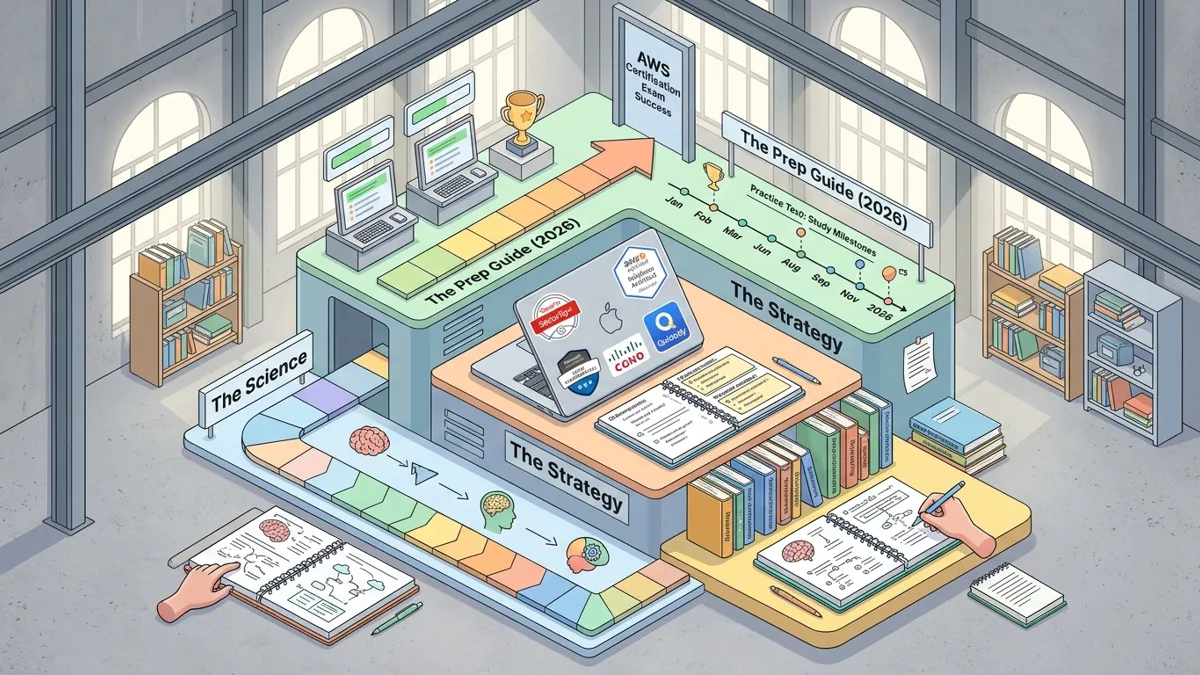
Preparing for modern EdTech and STEM certification exams requires moving beyond rote menu memorization. Because 2026 updates emphasize scenario evaluation and administrative troubleshooting, candidates should structure study schedules around proven cognitive principles:
1. Leverage Active Recall Practice: Test yourself using context-based scenarios rather than passively reviewing documentation. Practice selecting correct privacy settings for student data or configuring dynamic quiz feedback rules.
2. Apply Spaced Repetition: Spread study sessions over 3 to 4 weeks using structured intervals. For strategic planning, review our guide on spaced repetition study schedules for certification prep.
3. Create Portfolio Artifacts: Build functional lesson plans, automated grading templates, and AI prompt libraries while studying to apply concepts directly in the classroom and enrich your professional portfolio. Read more in our analysis of active recall research.
Frequently Asked Questions
Do Google Certified Educator badges expire?
Yes. Google Certified Educator Level 1 and Level 2 credentials are valid for three years from the issue date. Educators must complete the updated exam to maintain active credential status.
How long does it take to prepare for an EdTech certification?
Most active classroom teachers require 10 to 20 hours of focused preparation over 2 to 3 weeks for Google Certified Educator Level 1 or Level 2 exams. Microsoft Certified Educator prep typically requires 15 to 25 hours, while ISTE Certification involves a 14-week formal program and portfolio review.
Is the ISTE Certification worth the higher cost?
ISTE Certification is worth the higher investment ($750–$950) for educators pursuing district-level leadership, instructional coaching, or consulting roles. It emphasizes pedagogical design and systemic integration rather than specific software vendors, providing long-term value.
Can educators earn CEUs or academic credit for EdTech certifications?
Many public school districts grant Continuing Education Units (CEUs) or professional development credits for earning EdTech certifications. Educators should verify credit approval policies with their local district human resources office prior to exam registration.
Pass Your Exam with Active Recall
Validate your skills and earn your certification on your first attempt. Practice real-world scenario concepts using active recall flashcards and realistic mock exams.
Start practicing today with Quiztudy's active recall prep tools.
Google certifications (or AWS/Microsoft) are issued by their respective organizations, and Quiztudy is an independent practice platform.
Sources
1. https://www.businessresearchinsights.com/market-reports/stem-education-market-103310
2. https://www.grandviewresearch.com/industry-analysis/education-technology-edtech-market
3. https://www.globenewswire.com/news-release/2026/01/28/3016480/0/en/STEM-Education-in-K-12-Global-Strategic-Analysis-Report-2026-A-125-Billion-Market-by-2030-Driven-by-Leveraging-EdTech-Hands-on-Learning-and-Global-Partnerships-to-Enhance-Engageme.html
4. https://insightmarkresearch.com/edtech-statistics
5. https://learn.microsoft.com/en-us/credentials/certifications/microsoft-certified-educator/
6. https://chrmbook.com/google-certifications/
7. https://learn.microsoft.com/en-us/answers/questions/1690000/education-cost
8. https://edu.google.com/teach-with-google/certification/
9. https://www.bls.gov/ooh/education-training-and-library/instructional-coordinators.htm
10. https://www.indeed.com/career/instructional-designer/salaries
11. https://www.iste.org/certification
12. https://aws.amazon.com/certification/certified-cloud-practitioner/