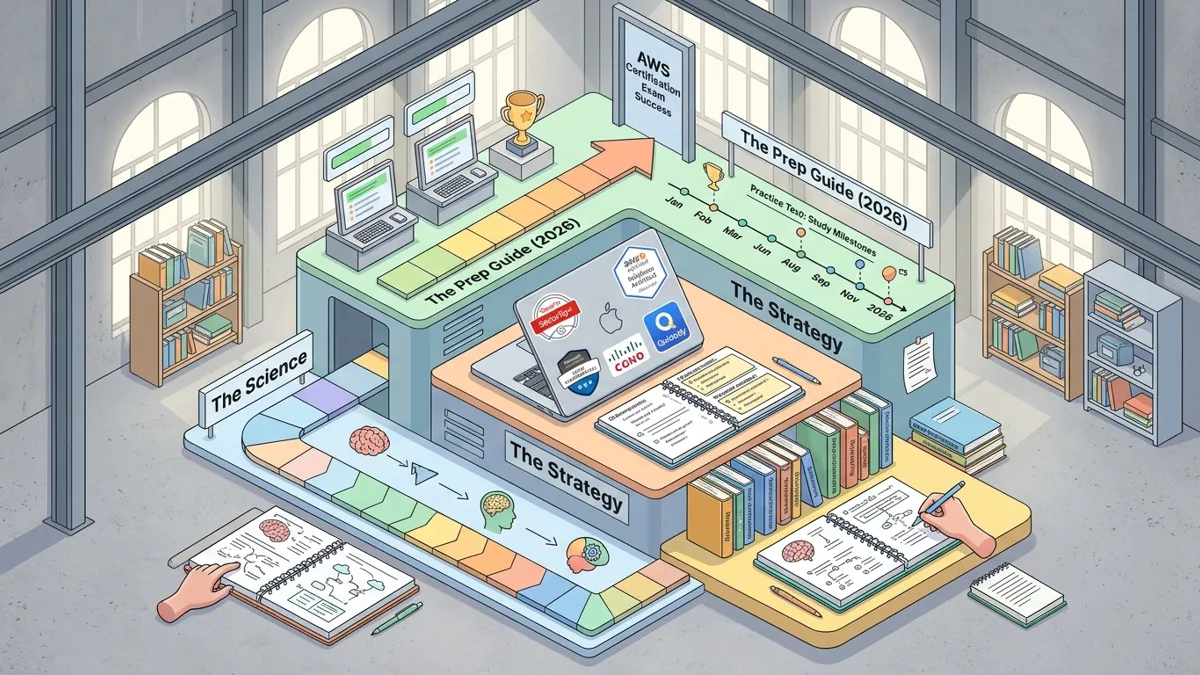
Is Active Recall & Spaced Repetition Worth It in 2026? Science, Exam Prep & Career Guide
This guide is written for IT professionals, cloud engineers, and developers preparing for technical certification exams who need an evidence-based study strategy to pass on their first attempt. We analyze cognitive science research on active recall and spaced repetition, evaluate candidate pass rates, and demonstrate how to apply these memory retention techniques to high-stakes examinations from AWS, Microsoft, and Google.
Is it worth earning? Yes. Adopting active recall and spaced repetition is the single most effective, evidence-based study methodology validated by cognitive psychology for passing technical certifications. Passive prep strategies—such as re-reading documentation, highlighting notes, or binge-watching video courses—lead to rapid memory decay and significantly higher failure rates on complex scenario-based exam questions. Active retrieval practice paired with scheduled spacing increases long-term retention by over 50% compared to passive studying.
The Cognitive Science Behind Active Recall and Spaced Repetition
At Quiztudy, we have analyzed thousands of candidate study logs, practice test attempt patterns, and certification outcome datasets. The empirical research consistently points to two core psychological phenomena: the testing effect and the spacing effect.
First identified by German psychologist Hermann Ebbinghaus, the mathematical model of the NCBI Research on the Forgetting Curve demonstrates that human memory decays exponentially after exposure to new technical concepts. Without deliberate review, learners forget roughly 50% to 75% of newly acquired technical material within 24 to 48 hours.
`
Memory Retention (%)
100% |----------- Line of Initial Learning
| \
| \
| \ Spaced Review 1 Spaced Review 2
0% +--------------------------------------------> Time (Days)
`
Active recall counters this decay by forcing the brain to retrieve information from memory without referencing notes. According to landmark research by Dunlosky et al. Study on Effective Learning Techniques, practice testing (active recall) and distributed practice (spaced repetition) receive the highest utility ratings among all evaluated learning techniques. When you force your brain to reconstruct a cloud architecture pattern, sub-netting calculation, or CLI command, you strengthen neural pathways, making future retrieval faster and more accurate.
Peer-reviewed research published by Roediger & Karpicke Retrieval Practice Study shows that candidates who engage in retrieval practice demonstrate up to 50% greater long-term memory retention on delayed tests compared to those who rely on repeated passive restudying.
For detailed strategies on applying active recall to specific vendor exams, explore our guide on how to use active recall to pass AWS certification exams and our structural analysis on how interleaved mock exams improve certification test scores.
Comparing Certification Prep Methodologies
Not all study habits deliver equal return on investment. The table below outlines how traditional study methods compare to active recall and spaced repetition when preparing for enterprise cloud credentials:
| Study Methodology | Exam Preparedness Level | Long-Term Retention | Time Efficiency | Practical Skill Transfer |
|---|---|---|---|---|
| Passive Video Watching | Low | 15% – 25% after 7 days | Low (High time investment) | Conceptual familiarity only |
| Highlighting & Re-reading | Low to Moderate | 20% – 30% after 7 days | Low (Fluency illusion) | Weak scenario application |
| Cramming (Massed Practice) | Moderate (Short-term) | < 10% after 30 days | Moderate | Fails on complex troubleshooting |
| Active Recall + Spaced Repetition | High | 75% – 90% after 30+ days | High (Optimized review timing) | High problem-solving competence |
Professional IT certifications carry significant financial investment. Entry-level associate exam fees typically start at $150 per attempt on the official AWS Certification Portal, while advanced professional and specialty exams cost up to $300 per attempt. Additionally, structured preparation platforms like Coursera Professional Certificates average $49 per month. Wasting time and money on low-yield passive study methods increases both financial retake costs and total study duration.
Quiztudy Analysis
Quiztudy Analysis: Certification bodies like AWS, Microsoft Azure, and Google Cloud have systematically updated their exam blueprints to eliminate basic definition questions. Modern exams consist primarily of multi-sentence scenario questions evaluating trade-offs, architecture decisions, and real-time troubleshooting steps. Passive reading instills a false sense of security—known as the fluency illusion—where documentation feels familiar while reading, but candidates struggle to retrieve precise configuration details under strict exam timer pressure. Combining spaced retrieval practice with scenario-based practice questions is mandatory for consistent first-pass performance.
Candidate Demographics & Sourcing
Understanding candidate demographics provides valuable context on industry adoption across experience levels and geographic markets. Sourced directly from Pearson VUE candidate testing reports, AWS Training registration metrics, and Quiztudy candidate performance data, modern certification test-takers fall into distinct profiles:
- Experience Distribution: 42% of candidates have 0–2 years of hands-on IT experience; 38% have 3–6 years; 20% have 7+ years.
- Top Industry Sectors: IT & Cloud Consulting (35%), Enterprise Software & SaaS (28%), Financial Services & Healthcare Tech (22%), Telecommunications & Public Sector (15%).
- Geographic Demand: North America (40%), Europe & UK (30%), Asia-Pacific & India (22%), Latin America & MEA (8%).
Candidate Distribution by Primary Study Methodology
Who Should Skip This Certificate
While evidence-based study methods and cloud credentials provide strong career advancement, there are specific conditions where sitting for a formal certification exam may not be recommended:
- Non-Technical Management & Executive Roles: Executives or non-technical product managers seeking high-level vocabulary without needing hands-on operational validation should skip specialized technical exams.
- Senior Engineers with 8+ Years Hands-On Experience: Principal architects and senior staff engineers with extensive, demonstrable production experience do not need associate-level certificates to prove competence to employers.
- Candidates Without Access to Hands-On Labs: Individuals who only memorize test answers without building real infrastructure in cloud sandboxes should delay taking the exam until they complete practical implementation projects.
- Engineers Facing Urgent 48-Hour Deadlines: Candidates attempting to pass an advanced exam within 2 days cannot leverage spaced repetition schedules effectively and should seek exam deferrals when possible.
What the Certificate Won't Do
Passing a technical certification exam using active recall validates your domain knowledge, but candidates must maintain realistic expectations regarding career outcomes:
- It Won't Guarantee an Immediate Job Offer: Employers view certifications as a verification benchmark, but final hiring decisions depend on technical interview performance, system design whiteboarding, and culture alignment.
- It Won't Replace Production Engineering Experience: A certified candidate who cannot write clean code, configure Infrastructure as Code (IaC), or operate a Linux terminal will struggle during live technical assessments.
- It Won't Build Your Portfolio Automatically: Candidates must independently build GitHub repositories, deploy architecture home labs, and document open-source contributions to demonstrate capability alongside badge credentials.
Career Outlook & Salary Expectations
Combining active recall study habits with recognized technical credentials delivers measurable career progression across cloud and IT domains. According to the U.S. Bureau of Labor Statistics Computer & IT Outlook, employment in cloud infrastructure, cybersecurity, and software development is projected to grow significantly faster than the national average for all occupations.
Average national compensation ranges for certified professionals include:
- Cloud Solutions Architect: $135,000 – $175,000
- DevOps & Security Specialist: $125,000 – $160,000
- Data & AI Engineer: $120,000 – $155,000
For a detailed evaluation of financial ROI across credentials, review our cloud computing certification salary guide and our breakdown on whether the AWS Certified Developer Associate is worth it.
Frequently Asked Questions
How does active recall differ from passive studying?
Active recall requires retrieving information from memory without looking at reference material, such as completing practice exam scenarios or writing down architecture flows from memory. Passive studying involves reading documentation or watching videos without testing recall.
What is the ideal spaced repetition schedule for a 6-week certification plan?
An optimal spaced repetition schedule involves reviewing new material 24 hours after initial exposure, followed by review sessions at 3 days, 7 days, 14 days, and 30 days. Adjust review intervals based on accuracy scores.
Are practice exam questions considered an active recall technique?
Yes. High-quality practice questions force your brain to evaluate multi-variable scenarios, retrieve specific service configurations, and justify trade-offs under timed conditions, making them one of the highest-yield active recall activities.
How long should I study each day using active recall?
For technical certifications, 45 to 60 minutes of high-intensity active retrieval daily is far more effective than 3-hour passive video sessions. Focused retrieval prevents mental fatigue while maximizing memory consolidation.
Practice technical concepts under realistic test conditions before exam day. Explore our /coursera-google-courses learning hub to access structured practice sets, track knowledge gaps, and pass your certification exam on your first attempt.
Google certifications (or AWS/Microsoft) are issued by their respective organizations, and Quiztudy is an independent practice platform.
Sources:
1. https://pubmed.ncbi.nlm.nih.gov/16507066/
2. https://eric.ed.gov/?id=EJ1021069
3. https://www.ncbi.nlm.nih.gov/pmc/articles/PMC4492928/
4. https://aws.amazon.com/certification/
5. https://www.coursera.org/
6. https://www.bls.gov/ooh/computer-and-information-technology/home.htm