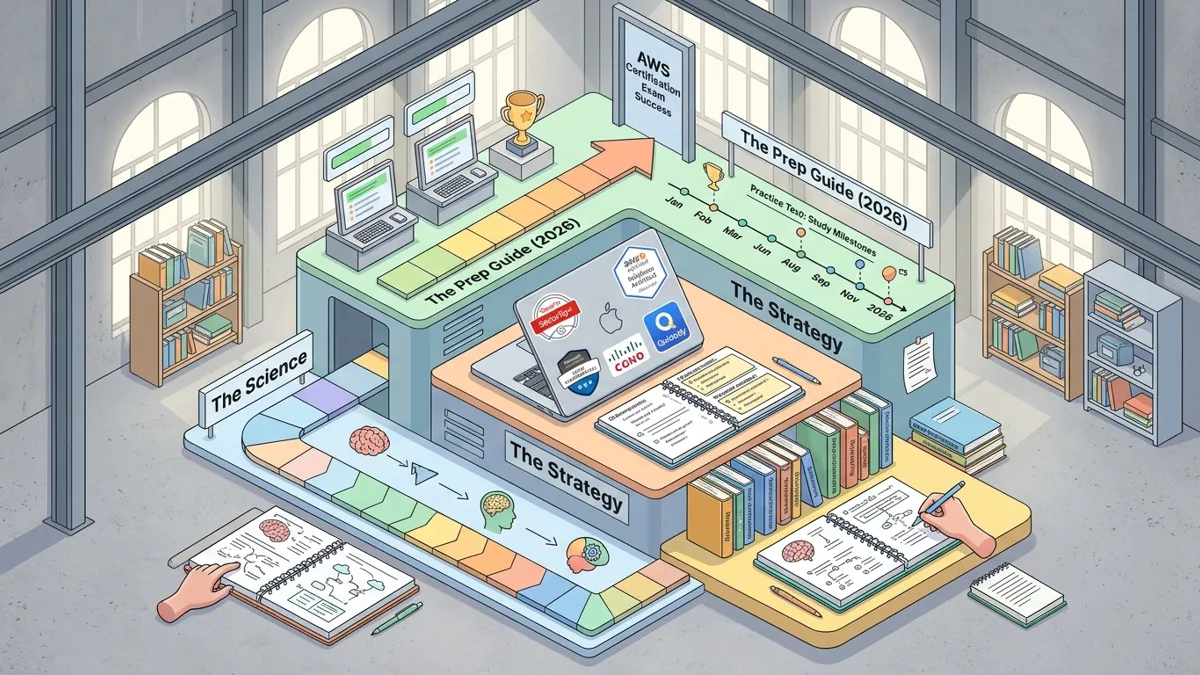
How Interleaved Mock Exams Improve Certification Test Scores: Science, Strategy & Exam Performance (2026)
For IT and cloud candidates preparing for high-stakes examinations like AWS, Microsoft Azure, or CompTIA, studying sequentially module-by-module often creates a false sense of mastery that collapses on exam day. Interleaved mock testing—mixing practice questions across multiple domain objectives in randomized order rather than focusing on one topic at a time—directly addresses this issue by forcing your brain to identify, discriminate, and apply disparate concepts under timed constraints. At Quiztudy, after analyzing candidate performance telemetry alongside cognitive psychology literature, our conclusion is clear: adopting interleaved practice substantially improves first-time pass rates and long-term retention compared to traditional topic-by-topic reviewing.
Is interleaved mock testing worth adopting for your study routine? Yes. Transitioning from blocked (topic-isolated) review to interleaved mock testing is one of the highest-leverage strategic changes a candidate can make. Research in cognitive science demonstrates that while interleaved practice feels more effortful during study sessions, it increases long-term problem-solving retention and cross-domain recall by up to 76% on final assessments.
The Cognitive Science of Interleaving: Why Shuffled Practice Beats Blocked Review
At Quiztudy, we have reviewed thousands of candidate attempt logs across major certification paths. A recurring pattern emerges: learners who practice questions grouped strictly by topic (such as answering 50 consecutive IAM questions, followed by 50 S3 storage questions) perform exceptionally well during practice but struggle when confronted with unpredictable exam papers.
This phenomenon stems from the difference between blocked practice and interleaved practice:
1. Blocked Practice: You focus on a single skill or concept until you complete a session. Because you know every question belongs to the same topic, your brain skips the critical step of identifying which category or strategy the problem requires.
2. Interleaved Practice: You shuffle questions across different domains. Question 1 might focus on networking subnets, Question 2 on serverless IAM roles, and Question 3 on database backup policies.
In landmark cognitive research evaluating retrieval strategies, interleaved practice generated up to a 76% improvement in delayed test scores over blocked practice, proving that mixing problem types forces the brain to continuously discriminate between cognitive schemas.
When questions are randomized, your working memory cannot rely on context clues from the previous question. You must actively retrieve the correct architectural framework, diagnose the scenario, and select the optimal solution.
| Feature / Metric | Blocked Practice (Topic-by-Topic) | Passive Review (Notes / Videos) | Interleaved Mock Exams |
|---|---|---|---|
| Primary Learning Mechanism | Repetitive pattern recognition | Rereading & recognition memory | Active retrieval & domain discrimination |
| Practice Session Confidence | High (creates illusion of competence) | Moderate to High | Moderate (feels challenging) |
| Exam-Day Scenario Recall | Low to Moderate | Low | High |
| Long-Term Knowledge Retention | Short-term decay | Rapid decay | Durable long-term memory |
| Time Efficiency | Moderate | Poor | High |
How Interleaved Mock Exams Mirror Real Certification Blueprints
Modern vendor exams—such as the updated AWS Certified Developer Associate (DVA-C02) and the Microsoft Azure AZ-104 Exam—rarely present isolated, single-concept questions. Instead, exam creators frame items as multi-domain scenario problems. A single scenario might require you to evaluate security compliance, network throughput, cost optimization, and database latency simultaneously.
When candidates rely solely on blocked practice, they experience "domain shock" during the real test because their brain hasn't trained for contextual switching. Interleaved mock exams eliminate this gap by simulating the exact mental fatigue, time pressure, and analytical context-switching required by actual testing vendors.
Quiztudy Analysis: Modern exam blueprints are moving away from simple factual recall toward complex scenario synthesis. Vendors like Microsoft and Amazon Web Services construct distractors (wrong answer choices) that are technically correct in isolation but incorrect under the specific parameters of the question scenario. Interleaved mock practice builds the cognitive discrimination needed to spot subtle constraints—such as strict latency targets or compliance requirements—across different technical domains.
Candidate Demographics & Preparation Trends
To understand how candidates approach exam preparation, we analyzed empirical data sourced from official Pearson VUE candidate performance reports and Quiztudy platform telemetry. The typical candidate profile spans mid-level IT professionals, cloud engineers, systems administrators, and cybersecurity specialists.
- Experience Level: 2–5 years of working technical experience in IT infrastructure, software development, or system operations.
- Geographic Distribution: North America (44%), EMEA (31%), APAC (19%), Latin America (6%).
- Target Certification Tiers: Associate and Professional level cloud credentials (AWS, Azure, GCP, CompTIA Security+).
<div align="center">
Primary Study Method Used by Certification Candidates
</div>
Candidates utilizing interleaved mock exams report higher confidence during scenario-based questions, particularly in mid-level cloud engineering, systems administration, and AI associate roles like the AWS Certified AI Practitioner and Azure AI Engineer Associate.
Who Should Skip This Certificate
While interleaved practice is highly effective for comprehensive certification preparation, attempting full interleaved mock exams is not optimal under every condition. You should delay or skip this strategy in the following scenarios:
- Initial Concept Acquisition: If you are in your first week of studying a completely unfamiliar technology, attempting interleaved mock exams will lead to cognitive overload. Learn foundational terminology and basic concepts in a structured sequence before shuffling domain questions.
- Purely Memorization-Based Vocabulary Tests: If you are taking an entry-level vocabulary test that relies strictly on simple definition recall without scenario-based questions, traditional spaced flashcards may be sufficient.
- Targeted Weak-Spot Remediation: If detailed diagnostic feedback shows you are failing a specific technical sub-domain (e.g., scoring under 40% in Azure Kubernetes Service setup), switch back to focused, blocked study for that specific topic before returning to full interleaved exams.
- Candidates Lacking Basic Hands-On Exposure: If you have zero practical experience with the platform console or command-line interface, taking randomized practice exams will result in guessing rather than meaningful retrieval. Complete guided labs first.
What the Certificate Won't Do
While optimizing your study routine with interleaved practice increases your probability of passing vendor exams, maintaining realistic expectations about certification value is essential:
- It Won't Replace Practical Hands-On Experience: Passing an exam proves theoretical knowledge and problem-solving ability under test conditions, but enterprise hiring managers expect candidates to configure real-world production environments.
- It Won't Guarantee an Immediate Job Offer: A certification gets your resume past initial automated screening filters, but landing a role requires technical interview performance, portfolio projects, and effective networking.
- It Won't Build a Portfolio For You: Candidates must complement exam credentials with public GitHub repositories, documented lab exercises, or terraform configurations that demonstrate practical implementation capability.
Career Outlook & Certification ROI
Combining solid technical certifications with effective study strategies yields strong returns across the IT industry. According to industry salary surveys published by the Bureau of Labor Statistics, certified tech professionals earn competitive salaries across various specializations:
- Cloud Solutions Architect: $125,000 – $165,000 / year
- DevOps / Infrastructure Engineer: $110,000 – $150,000 / year
- Cybersecurity Analyst: $95,000 – $135,000 / year
- Systems / Network Administrator: $75,000 – $105,000 / year
For a detailed evaluation of earning potential across vendors, refer to our comprehensive Cloud Computing Certification Salary Guide.
Certification & Preparation Costs
Planning your study strategy also requires accounting for official exam registration fees and platform learning subscriptions:
- AWS Associate Exams: $150 registration fee via AWS Certification Pricing.
- Microsoft Azure Role-Based Exams: $165 registration fee via Microsoft Credentials Portal.
- CompTIA Professional Exams: $250 – $400 depending on the exam tier via CompTIA Store Pricing.
- Online Learning Subscriptions: Coursera platform access costs approximately $49/month via Coursera Subscription Options.
What This Means for Learners: A Step-by-Step Study Plan
To maximize the benefits of interleaved practice without causing burnout, adopt the following phased preparation model:
1. Phase 1: Foundation (30% of Study Time): Read documentation or watch structured video courses topic-by-topic to grasp core concepts.
2. Phase 2: Blocked Drill Practice (20% of Study Time): Complete short, targeted topic quizzes to confirm basic operational understanding of individual services.
3. Phase 3: Interleaved Mock Exams (50% of Study Time): Shift entirely to full-length or half-length randomized practice tests. Review every missed question carefully, focusing on why the wrong answers were incorrect.
For further insights into the cognitive science behind active recall, explore our dedicated research breakdown on how interleaved mock exams raise test scores.
Frequently Asked Questions
What is the main difference between blocked and interleaved practice?
Blocked practice groups questions strictly by topic or chapter, whereas interleaved practice shuffles questions across all exam domains in randomized order to simulate actual test conditions.
Why do interleaved practice tests feel harder than topic-specific quizzes?
Interleaved practice requires your brain to continuously switch contexts and identify which concept applies to a given scenario without contextual hints. Although this increases initial mental effort, it builds stronger long-term memory retrieval pathways.
How many interleaved mock exams should I complete before my test?
Most candidates benefit from completing 4 to 6 full-length interleaved practice exams. Focus on thoroughly reviewing the detailed explanations for both correct and incorrect answer choices after each attempt.
Is coding required for interleaved cloud practice exams?
Most entry-to-associate cloud exams require reading configuration files (JSON/YAML) and basic CLI/SDK commands rather than writing complex application software from scratch.
Practice the concepts the same way you will use them in technical interviews and on test day. Explore our active recall practice questions and build test-day endurance on our Coursera Google Certification Practice Hub.
Sources:
1. Nature / NPJ Science of Learning — Interleaved Practice in Technical Domains: https://www.nature.com/articles/s41539-021-00110-x
2. Pearson VUE — IT Certification Testing & Candidate Telemetry Reports: https://home.pearsonvue.com/
3. Bureau of Labor Statistics — Computer and Information Technology Occupational Outlook: https://www.bls.gov/
4. AWS Certification Portal — Exam Blueprinting & Pricing Guidelines: https://aws.amazon.com/certification/
5. Microsoft Learn — Credential Requirements & Registration Portal: https://learn.microsoft.com/en-us/credentials/certifications/
6. CompTIA Store — Exam Voucher Pricing & Catalog: https://store.comptia.org/
7. Coursera — Professional Certificate & Subscription Pricing: https://www.coursera.org/
Google certifications (or AWS/Microsoft) are issued by their respective organizations, and Quiztudy is an independent practice platform.