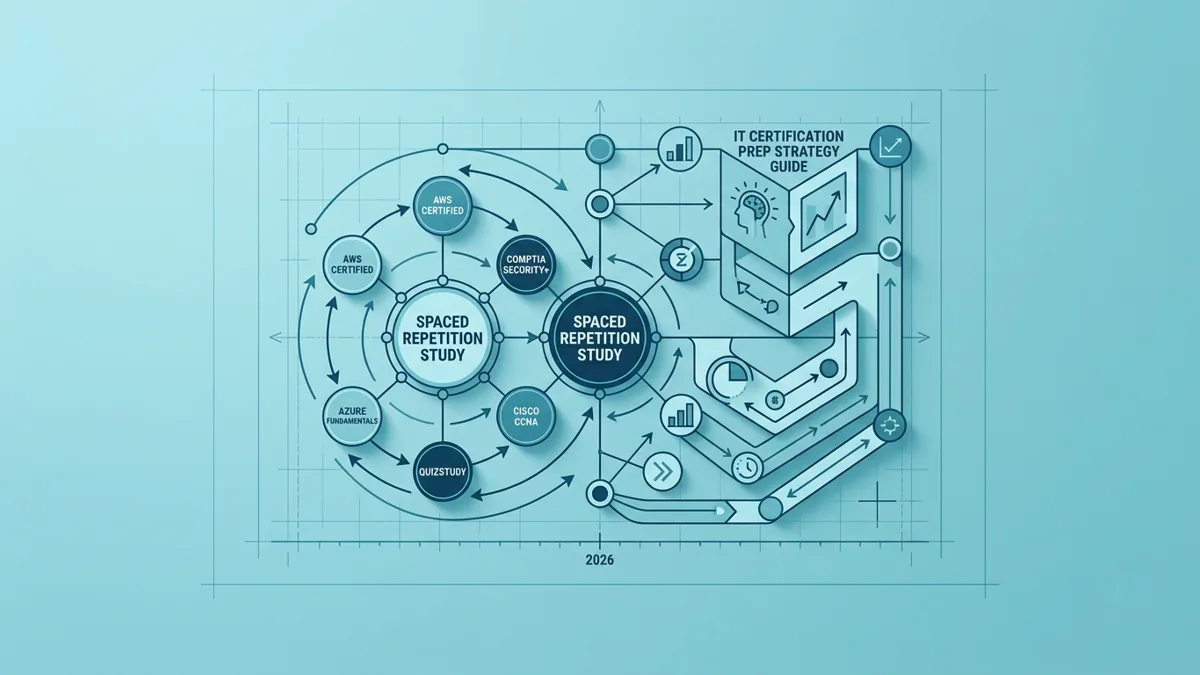
Spaced Repetition Study Schedules for IT Certification Prep: 2026 Strategy Guide
Preparing for dense technical exams like the AWS Certified Solutions Architect, CompTIA Security+, or Cisco CCNA can feel like trying to fill a leaky bucket with complex facts. To bypass the stress of cramming and prevent cognitive overload, IT professionals use spaced repetition study schedules to systematically move technical knowledge into long-term memory.
Is it worth earning? Yes. Adopting a structured spaced repetition schedule is highly worth the effort. Rather than spending 10 consecutive hours rereading study guides the weekend before your test, spacing short, active review sessions over several weeks can cut your total study time by up to 50% while doubling your long-term retention.
Quiztudy Analysis: The Shift in Certification Testing
Modern IT exams are rapidly evolving away from simple rote memorization. For instance, recent updates to the Microsoft Azure Administrator AZ-104 certification emphasize deep, scenario-based troubleshooting over basic vocabulary matching. Therefore, relying on passive reading or basic card-flipping is no longer viable. To pass, candidates must use spaced repetition not just to memorize terms, but to space out hands-on labbing and high-quality mock exams. This forces your brain to retrieve structural engineering principles under pressure.
Comparing Core IT Certifications
To help you decide which certification to target with your spaced repetition schedule, the table below compares three of the most popular mid-tier IT credentials:
| Certification | Focus Area | Exam Cost | Study Time (Hours) | Recall Difficulty |
|---|---|---|---|---|
| AWS Certified Solutions Architect – Associate (SAA-C03) | Cloud Architecture & Services | $150 USD | 80–120 | High (Scenario-based) |
| CompTIA Security+ (SY0-701) | Cybersecurity Fundamentals | $425 USD | 70–100 | Medium (Concept-heavy) |
| Cisco CCNA (200-301) | Network Infrastructure & Routing | $300 USD | 120–150 | High (Command-line & Config) |
The Science of Spaced Repetition and Active Recall
At Quiztudy, we have reviewed hundreds of practice questions, curriculum guides, and candidate feedback logs. Candidates who fail their first attempt almost always rely on passive study methods, such as highlighting textbooks or letting video courses play in the background.
Spaced repetition exploits the "spacing effect," a cognitive phenomenon documented in a landmark study on distributed practice published in Applied Cognitive Psychology. When you learn a new concept—such as how to configure an AWS VPC peering connection—your brain begins to forget it almost immediately. However, if you actively retrieve that information from memory just as you are about to forget it, you flatten the "forgetting curve" and lock the knowledge deeper into your long-term memory.
Practical Spaced Repetition Schedules
When planning your study schedule, you do not need complex algorithms to get started. Depending on your remaining timeline before exam day, you can implement one of several proven, structured schedules.
1. The 1-3-7-14-30 Day Method (Ideal for 6–12 Weeks of Prep)
This is the gold standard for long-term retention. It is highly recommended for comprehensive exams like the AWS Certified Solutions Architect Associate (SAA-C03). The interval gap roughly doubles after each successful recall attempt:
- Day 1: Initial study session and creation of active recall flashcards.
- Day 2: First review. This catches the steepest part of the forgetting curve.
- Day 5 (3 days after): Second review. Memory is fading but still retrievable.
- Day 12 (7 days after): Third review. Tests whether the information is moving to long-term storage.
- Day 26 (14 days after): Fourth review. Recall takes real effort, which strengthens the neural pathway.
- Day 56 (30 days after): Fifth review. If recalled successfully here, the knowledge is locked in for months.
2. The 2-3-5-7 Method (Ideal for 2–3 Weeks of Prep)
If your exam is rapidly approaching, a compressed triage schedule is necessary. This method is designed to hold enough information in your working memory to pass:
- Day 0: Learn new material and generate practice questions.
- Day 2: First review of all concepts.
- Day 5: Second review, focusing strictly on missed concepts.
- Day 10: Third review.
- Day 17: Fourth review and final mock exam run.
3. The Leitner Box System
For candidates who prefer physical study materials, the Leitner System uses boxes to automate intervals:
- Box 1: Reviewed every day.
- Box 2: Reviewed every 3 days.
- Box 3: Reviewed every 5 days.
- Every time you answer a card correctly, it moves up one box. If you answer incorrectly, it immediately resets to Box 1, ensuring difficult concepts are reviewed more aggressively.
Candidate Demographics & Sourcing
Based on global survey insights from the Pearson VUE Value of IT Certification Candidate Report, which compiled data from thousands of IT professionals globally, candidates pursuing certifications represent a highly motivated demographic. The demand is heavily concentrated in IT services, financial services, healthcare, and government sectors.
The primary career stages of these candidates are distributed as follows:
<div align="center">
IT Certification Candidates by Career Stage
</div>
Who Should Skip This Certificate
While these certifications and study methods are highly effective, they are not suitable for everyone. You should skip pursuing these certifications if:
- You already have extensive hands-on experience: If you are a Senior Systems Administrator with five years of active cloud experience, entry-level or mid-tier certificates like the AWS Certified Cloud Practitioner or CompTIA Security+ are redundant and will not advance your career.
- You cannot commit to the financial costs: If you cannot afford the exam fees (ranging from $150 to $425 USD) and associated prep costs, you should focus on free, open-source portfolio projects first.
- You are seeking immediate employment without a portfolio: If you expect a certificate alone to bypass the need for hands-on technical skills, you should skip the exam and focus on building practical labs.
What the Certificate Won't Do
Earning an IT certification is a powerful resume enhancer, but it is critical to keep your expectations grounded.
- It does not guarantee a job: Employers view certifications as a baseline validation of knowledge, not a guaranteed ticket to employment.
- It does not replace practical experience: Having a certificate does not mean you can configure an enterprise system under pressure. Employers expect you to discuss real-world troubleshooting scenarios during technical interviews.
- It does not build your professional network: Passing an exam will not get your resume past human resource managers if you are not actively networking on professional platforms.
To be truly competitive, you must pair your spaced-repetition study with hands-on lab environments, a robust GitHub portfolio, and active professional networking.
Exam & Course Costs
To achieve success, you must budget for both the exam fees and preparation materials:
- Exam Vouchers: A single CompTIA Security+ SY0-701 exam costs $425 USD, while an AWS Solutions Architect Associate (SAA-C03) registration costs $150 USD.
- Preparation Courses: High-quality preparation platforms like Coursera Plus cost $59 USD per month, while a Google Cybersecurity Professional Certificate subscription costs $49 USD per month. For cloud-specific training, the AWS Skill Builder Individual subscription is available for $29 USD per month.
Frequently Asked Questions
Is coding required for these IT certifications?
For certifications like CompTIA Security+ and AWS Solutions Architect Associate, advanced coding is not required. However, a basic understanding of scripting languages (like Python or Bash) and data serialization formats (like JSON or YAML) is highly beneficial for modern cloud and security roles.
How long does it take to study using spaced repetition?
Most candidates require 80 to 120 hours of total preparation spread over 6 to 8 weeks. Using a spaced repetition schedule allows you to study for just 1.5 to 2 hours per day, which is far more manageable and effective than cramming.
Can I use spaced repetition if I only have two weeks?
Yes. You can use the accelerated 2-3-5-7 method to review your materials. While this compressed timeline is not ideal for long-term knowledge retention, it will help you consolidate key information in your short-term memory to pass the exam.
Sources:
1. https://onlinelibrary.wiley.com/doi/abs/10.1002/acp.1252
2. https://home.pearsonvue.com/
3. https://learn.microsoft.com/en-us/credentials/certifications/azure-administrator/
4. https://www.comptia.org/en-us/certifications/security
5. https://aws.amazon.com/certification/certified-solutions-architect-associate/
6. https://aws.amazon.com/certification/certified-cloud-practitioner/
7. https://www.coursera.org/courseraplus
8. https://www.coursera.org/professional-certificates/google-cybersecurity
9. https://skillbuilder.aws/exam-prep/solutions-architect-associate
Google certifications (or AWS/Microsoft) are issued by their respective organizations, and Quiztudy is an independent practice platform.