Is Learning Python Still Worth It in 2026? Job Market Outlook, Salary & Career Guide
As artificial intelligence and automated workflows continue to reshape the global technology landscape, many professionals are wondering if dedicating time to Python is still a viable career strategy. At Quiztudy, we have analyzed real-world job boards, developer surveys, and practice metrics to evaluate Python's standing in today's hiring environment.
Is Python worth learning and certifying in for 2026? Yes. Python remains an essential foundation for modern technical roles, but the way you must demonstrate your skills has radically changed. The era of getting hired by simply knowing basic syntax is over; today's employers prioritize candidates who can integrate Python with cloud platforms, configure APIs using frameworks like FastAPI, and manage AI-driven workflows.
Python's Structural Dominance in the 2026 Tech Landscape
Python’s lead at the top of the programming language charts has become structural, not cyclical. According to the TIOBE Programming Index, Python comfortably maintains its position as the world's most popular programming language. This dominance is not merely about search engine visibility; it is driven by massive, real-world adoption.
The most recent Stack Overflow Developer Survey revealed that 57.9% of developers worldwide use Python in their daily workflows, marking a massive 7 percentage point increase year-over-year—the largest single-year jump recorded for any major language in the survey’s history. Furthermore, recruitment analysis indicates that a significant percentage of tech recruiters actively look for Python skills when hiring. This growth is heavily tied to the rise of artificial intelligence, machine learning, and data engineering. Python is the native tongue of modern AI orchestration.
Candidate Demographics & Sourcing
To understand who is actually learning and using Python in 2026, we analyzed demographic data from the Python Software Foundation Developer Survey. The data shows that Python’s footprint spans far beyond traditional software engineering, heavily penetrating data roles and IT automation fields.
<center>
Python Professional Use Cases in 2026
</center>
While the majority of users are concentrated in web and backend development, the share of developers utilizing Python for data science, machine learning, and cloud infrastructure automation has steadily grown. Geographically, the highest concentration of high-paying Python roles remains in major U.S. tech hubs, though remote-first roles across Europe and North America have normalized competitive pay scales.
Quiztudy Analysis: The AI Paradox
Quiztudy Analysis: The rapid rise of generative AI tools like GitHub Copilot and Cursor has created an interesting paradox. While AI can write basic Python syntax instantly, it has actually increased the demand for skilled Python engineers.
At Quiztudy, we have reviewed hundreds of practice questions and job boards, and we have noticed that employers are shifting their interview patterns away from rote syntax memorization. Instead, they are testing architectural understanding: how to structure modular, object-oriented code, handle exceptions gracefully, and debug AI-generated code. Because AI solutions are often "almost right, but not quite," companies need human engineers who can verify, secure, and scale the code.
Comparison of Python Learning & Certification Paths
| Certification | Focus Area | Exam Cost | Delivery Method | Best For |
|---|---|---|---|---|
| PCEP™ (Certified Entry-Level Python Programmer) | Basic syntax, data types, loops, and simple functions. | $69 USD | Online, unproctored (TestNow) | Absolute beginners and career switchers. |
| PCAP™ (Certified Associate Python Programmer) | Object-oriented programming (OOP), packages, modules, and exceptions. | $295 USD | Proctored (Pearson VUE / TestNow) | Aspiring software developers and mid-level engineers. |
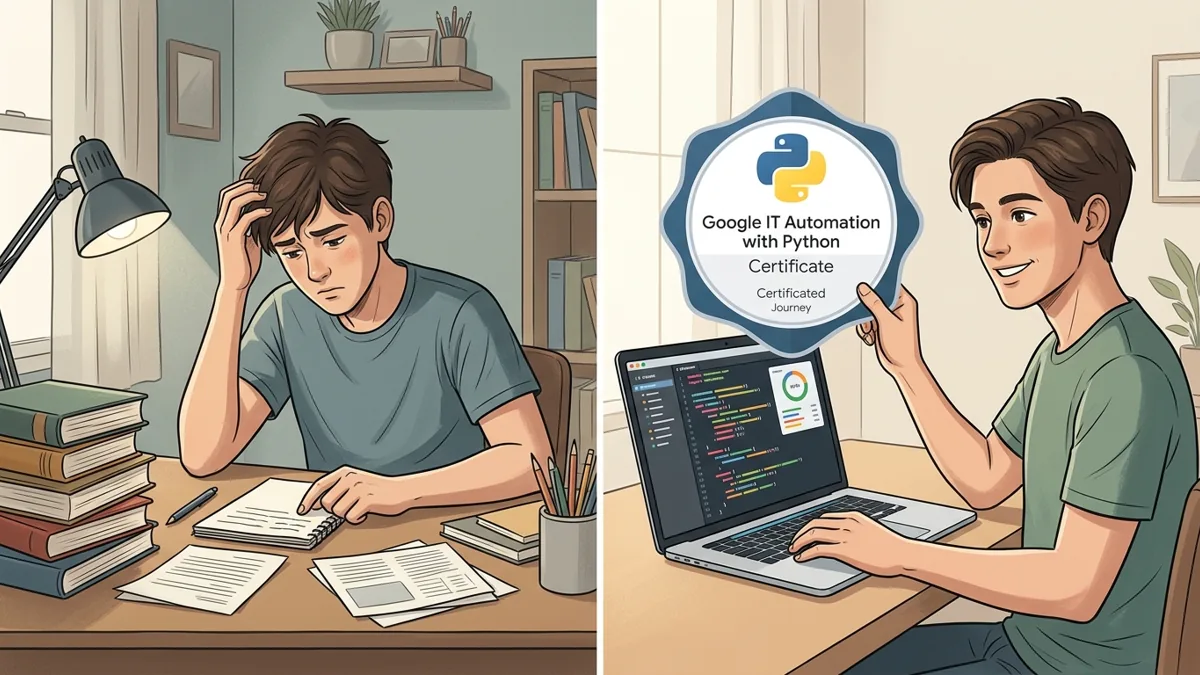
| Google IT Automation with Python (Professional Certificate) | IT automation, Git/GitHub, system administration, and cloud configuration. | $49/month Coursera subscription | Self-paced projects & labs | Sysadmins, DevOps engineers, and IT support professionals. |
| IBM Full Stack Software Developer (Professional Certificate) | Cloud-native applications, Django, backend databases, and deployment. | $49/month Coursera subscription | Self-paced projects & labs | Full-stack developers and backend engineers. |
Who Should Skip This Certificate
While Python certifications can accelerate your learning, they are not universally necessary. You should skip these certifications if you meet any of the following conditions:
- You already have a computer science degree or 2+ years of software engineering experience: If you are transitioning from languages like Java, C++, or Go, do not waste money on entry-level syntax certifications. Instead, build a public portfolio showing your ability to work with Python frameworks like FastAPI or PyTorch.
- You are a pure front-end developer: If your main goal is to build user interfaces (UI/UX) using React or Vue, your time is better spent mastering JavaScript, TypeScript, and CSS.
- You already have a robust GitHub portfolio: If you can point to 2-3 live, deployed backend projects with solid documentation, multiple-choice certifications like PCEP or PCAP will add very little marginal value to your resume.
- You expect a certification to guarantee employment: No certification will bypass the need for networking, building actual projects, and passing technical coding interviews.
Exam & Course Costs
Understanding the financial investment required is crucial before committing to a certification path. Here is a breakdown of the direct costs associated with the top Python credentials:
- PCEP (Certified Entry-Level Python Programmer): The exam voucher costs $69 USD. Preparation materials are free through the Python Institute, making this a low-cost entry point.
- PCAP (Certified Associate Python Programmer): The exam costs $295 USD per attempt. Prep courses on third-party platforms typically range from $15 to $100, though the official Python Institute training is free.
- Google IT Automation with Python Professional Certificate: Coursera charges a $49/month Coursera subscription. Since most students complete the certificate in 3 to 6 months, the total cost ranges between $147 and $294.
- IBM Full Stack Software Developer Professional Certificate: This also operates on a $49/month Coursera subscription, with a typical completion window of 6 to 10 months, costing approximately $294 to $490.
What the Certificate Won't Do
No Python certification—whether issued by the Python Institute or Google—will automatically land you a job. In 2026, the tech recruitment pipeline is highly automated and heavily values practical demonstration over paper credentials. Here is what a certificate won't do:
- It won't bypass technical interviews: You will still have to pass live coding challenges, system design reviews, and behavioral interviews.
- It won't replace a portfolio: A certificate tells a hiring manager you passed a test; a GitHub repository containing clean, documented, and deployed code proves you can actually do the work.
- It won't make up for lack of networking: Most roles are filled through referrals and professional networking. Relying solely on cold-applying with a certificate on your LinkedIn profile will result in low response rates.
Career Outlook & Salary Expectations
Python developers command highly competitive salaries in 2026, though total compensation varies drastically by your specialization and experience level:
- Junior Python Developer / Automation Specialist (0-2 years): Salaries range from $80,000 to $95,000. At this level, you are expected to write basic scripts, debug simple applications, and use basic cloud services.
- Mid-Level Python Engineer / Data Engineer (3-5 years): Average salaries range from $115,000 to $133,000. Engineers at this level design APIs, build ETL pipelines, and manage relational and non-relational databases.
- Senior Python Developer / ML Engineer (6+ years): Salaries comfortably clear $140,000 to over $200,000. Senior developers architect complex distributed systems, integrate custom machine learning models, and lead engineering teams.
Frequently Asked Questions
Which Python certification is best for beginners in 2026?
The PCEP™ (Certified Entry-Level Python Programmer) is the best starting point for absolute beginners who want a low-cost, structured way to validate their basic syntax and logic skills. If you are specifically interested in IT operations or systems administration, the Google IT Automation with Python Certificate is highly recommended.
Is the Python job market oversaturated in 2026?
Only at the entry-level syntax-only tier. There is an oversupply of candidates who only know basic Python syntax. However, there remains a significant shortage of mid-level and senior engineers who can combine Python with cloud architectures, API development (FastAPI), and machine learning frameworks.
How much does a Python Developer earn in 2026?
The median U.S. salary for Python developers ranges from $118,000 to $133,000. Entry-level roles start around $80,000 to $95,000, while senior backend and machine learning specialists regularly exceed $170,000 to $200,000.
Do Python certifications expire?
Python Institute certifications (like PCEP and PCAP) are valid for 5 years from the date they are earned. Coursera-based professional certificates (like Google's or IBM's) do not have a formal expiration date but should be updated on your resume with continuous project work.
Sources:
1. Stack Overflow 2025 Developer Survey: https://survey.stackoverflow.co/2025/
2. Python Institute PCEP Certification: https://pythoninstitute.org/pcep
3. Python Institute PCAP Certification: https://pythoninstitute.org/pcap
4. Coursera Google IT Automation with Python Professional Certificate: https://www.coursera.org/professional-certificates/google-it-automation
5. Coursera IBM Full Stack Software Developer Professional Certificate: https://www.coursera.org/professional-certificates/ibm-full-stack-cloud-developer
6. Python Software Foundation Developer Survey Statistics: https://pynions.com/python-statistics/
7. TIOBE Programming Index: https://www.tiobe.com/tiobe-index/
Google certifications (or AWS/Microsoft) are issued by their respective organizations, and Quiztudy is an independent practice platform.