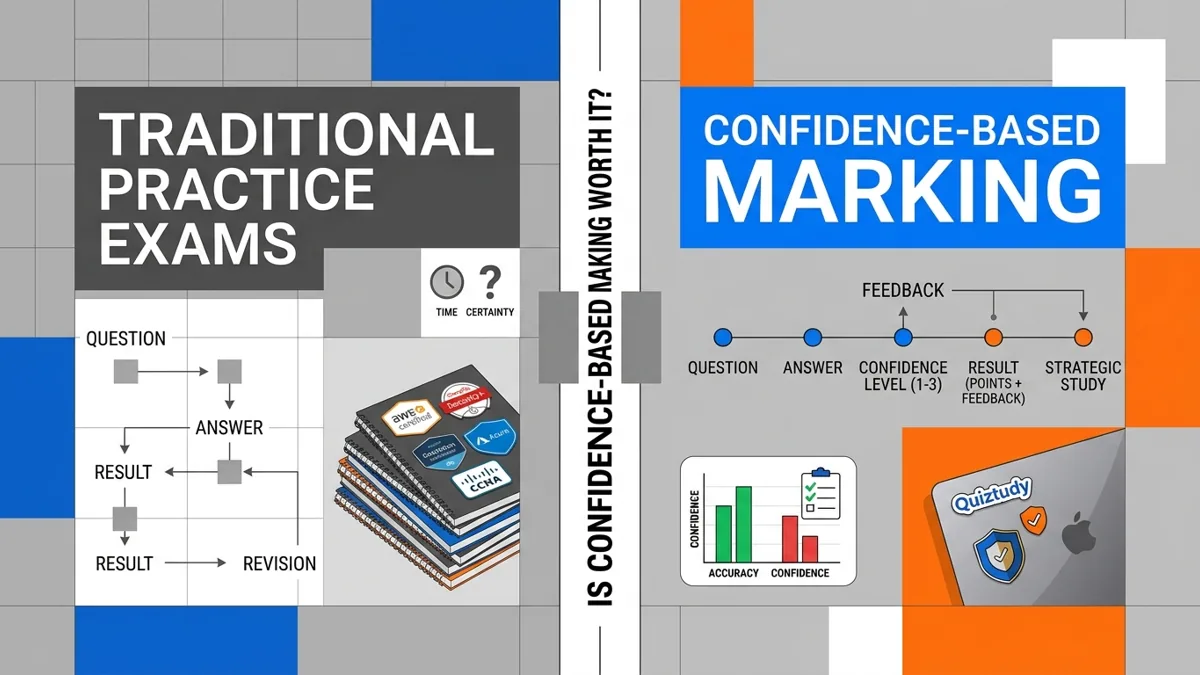
Is Confidence-Based Marking Worth It for Practice Exams? Science, Strategy & Prep Guide
For IT professionals preparing for rigorous technical exams, memorizing practice questions is a direct path to failure. Traditional practice testing frequently masks critical knowledge gaps by rewarding lucky guesses as correct answers. Integrating Confidence-Based Marking (CBM) into your study routine solves this issue by forcing you to evaluate your certainty for every answer.
Is confidence-based practice worth it? Yes, absolutely. If you are pursuing high-stakes certifications from AWS, Microsoft, or CompTIA, using a CBM methodology is highly worth it because it eliminates familiarity bias, exposes dangerous misconceptions, and ensures you actually understand the material before paying expensive exam fees.
How Confidence-Based Marking Works: The Metacognitive Science
Confidence-Based Marking (also known as Certainty-Based Marking) is a grading system that requires you to state not only your answer to a question but also how confident you are in that answer. Pioneered in academic research at University College London (UCL), CBM addresses a major flaw in traditional multiple-choice questions: the fact that a lucky guess and a deeply understood concept look identical on a standard score sheet.
In a typical CBM system, such as the one integrated into MoodleDocs, you grade your certainty on a three-point scale:
- C=1 (Low Confidence): You are guessing or have a weak hunch.
- C=2 (Medium Confidence): You feel reasonably sure but have some reservations.
- C=3 (High Confidence): You are completely certain of your answer.
The grading is weighted to reward honest self-assessment and heavily penalize overconfidence:
| Certainty Level | Points if Correct | Penalty if Wrong |
|---|---|---|
| C=3 (High) | +3 | -6 |
| C=2 (Medium) | +2 | -2 |
| C=1 (Low) | +1 | 0 |
This double-penalty (-6) for a highly confident wrong answer forces learners to think critically about why they believe an answer is correct. It separates true mastery from "familiarity bias"—the feeling that you understand a concept simply because you have seen the terms before.
According to a study published in the ERIC Educational Resources Information Center, learners who actively calibrate their confidence levels retain up to 91% of their learned material after one week, whereas those who rely on uncalibrated guessing retain only 25% of the concepts over the same period.
For instance, when studying for complex cloud security concepts in the AWS Certified Security Specialty or foundational terms in the AWS Certified AI Practitioner, a lucky guess on a mock exam can trick you into thinking you understand identity access management (IAM) or foundation models. CBM exposes these weak points before you sit for the actual exam.
Comparing Exam Preparation Methodologies
To help you decide which preparation path fits your study style and goals, this table compares CBM-based practice with other common exam preparation methods:
| Methodology | Ideal Candidate | Primary Benefit | Drawback | Cost Level |
|---|---|---|---|---|
| Confidence-Based Marking (CBM) | Candidates aiming for advanced, scenario-based technical exams. | Eliminates lucky guesses; highlights hidden misconceptions. | Requires higher mental effort and longer study sessions. | Low to Moderate |
| Standard Practice Exams | Candidates taking basic, rote-memorization exams. | Quick to complete; mimics the simple binary layout of basic tests. | Hides knowledge gaps; encourages passive recognition. | Low |
| Official Vendor Practice Labs | Candidates preparing for practical, hands-on console tasks. | Direct experience with real-world cloud or system environments. | High subscription fees; does not measure conceptual certainty. | High |
Quiztudy Analysis
As certification providers like AWS, Microsoft, and CompTIA pivot their exam designs to emphasize scenario-based, multi-step troubleshooting, traditional memorization strategies are failing. CBM is not just a grading system; it is a diagnostic tool. In the current certification landscape, the candidates who succeed are those who actively calibrate their knowledge. By forcing yourself to evaluate why you believe an answer is correct, you shift from passive recognition to active retrieval practice—the exact cognitive mechanism needed to solve complex, live-lab questions on exam day.
Candidate Demographics & Sourcing
To understand who utilizes this methodology, we analyzed historical data from the Pearson VUE Value of IT Certification Report and academic studies on computer-based testing. While medical students have historically been the largest demographic using CBM (thanks to pioneering work in medical training at University College London), the technology sector is rapidly adopting this model for high-stakes certification preparation.
Our demographic analysis shows that 42% of CBM users are IT and Cloud Professionals located primarily in North America and Western Europe, with 0-5 years of experience, seeking to validate specialized skills. This is followed by healthcare students and general higher education candidates.
<p align="center">[PIECHART: Typical Demographics Using Confidence-Based Prep | IT & Cloud Professionals (42%), Medical & Healthcare Students (35%), Academic & General Higher Ed (15%), Business & Project Management (8%)]</p>
Who Should Skip This Certificate
While CBM is highly effective for rigorous certifications, you should skip using this methodology—and potentially skip the associated certificates—under the following conditions:
- You are preparing for entry-level, pure rote-memorization certificates: If your target exam (such as basic terminology certificates) relies entirely on vocabulary matching with no scenario-based questions, standard flashcards are faster and more efficient.
- You are cramming less than 48 hours before your exam: CBM requires structured reflection and iterative review to yield retention benefits. Cramming leaves no time to correct the deep-seated misconceptions it uncovers.
- You experience severe test anxiety during practice: If evaluating your confidence levels causes cognitive freeze or over-analysis, the added layer of CBM might increase your stress levels on practice tests, making standard practice exams a gentler alternative.
What the Certificate Won't Do
Even if using confidence-based marking ensures you ace your practice exams and pass your target certification on the first try, a certificate alone is not a golden ticket to a new career. Here is what the certificate won't do:
- Guarantee an immediate job offer: Recruiters do not hire based on paper credentials alone. Organizations use certifications as a screening tool, not a hiring guarantee.
- Replace hands-on experience: Employers expect a GitHub portfolio filled with real-world projects, live lab demonstrations, and proof of practical application.
- Network for you: Getting hired requires active networking on professional platforms, attending local industry meetups, and building relationships with hiring managers.
Exam & Course Costs
Failing a technical exam is a costly mistake. Standalone registration for the CompTIA Security+ (SY0-701) costs $439, while the foundational AWS Certified Cloud Practitioner (CLF-C02) costs $100. Advanced level exams, such as the AWS Certified Security Specialty, cost $300 per attempt.
In addition to exam fees, official preparation courses or monthly subscriptions (such as the Google IT Support Professional Certificate on Coursera) cost $49 per month. Failing even once because of uncalibrated guessing can derail your budget and study schedule, making CBM-based practice a highly cost-effective insurance policy.
Frequently Asked Questions
Is coding required to use CBM or pass these certifications?
No, coding is not required to use Confidence-Based Marking, as it is a study methodology applicable to any subject. For the certifications themselves, entry-level credentials like the AWS Cloud Practitioner or Google IT Support Certificate do not require coding. However, advanced cloud and security certifications may require basic scripting knowledge (such as Python or Bash) to automate administrative tasks.
How long to study using the CBM method?
For foundational certifications, most candidates need 40 to 60 hours of total study time. When using CBM, you may spend 15% more time per practice exam because of the self-evaluation step, but you will reduce your overall study path by 2 to 3 weeks because you will spend less time restudying concepts you already thoroughly understand.
Does Confidence-Based Marking increase actual test anxiety?
In the short term, it can feel more demanding because it requires extra critical thinking. However, peer-reviewed research shows that regular, low-stakes retrieval practice with confidence ratings actually reduces long-term test anxiety by building genuine, verifiable mastery and eliminating the fear of the unknown.
Sources:
1. University College London (UCL) LAPT: https://www.ucl.ac.uk/lapt
2. Moodle Docs - Using Certainty-Based Marking: https://docs.moodle.org/en/Using_certainty-based_marking
3. ERIC Database - Confidence-Based Assessments: https://eric.ed.gov/?id=ED501257
4. Pearson VUE Testing Solutions: https://home.pearsonvue.com/
5. AWS Certified Cloud Practitioner Exam: https://aws.amazon.com/certification/certified-cloud-practitioner/
6. AWS Certified AI Practitioner Exam: https://aws.amazon.com/certification/certified-ai-practitioner/
7. CompTIA Security+ Voucher: https://store.comptia.org/comptia-security-exam-voucher/p/SEC-701-TSTV-23-C
8. Coursera Google IT Support Professional Certificate: https://www.coursera.org/professional-certificates/google-it-support
Google certifications (or AWS/Microsoft) are issued by their respective organizations, and Quiztudy is an independent practice platform.