Is CompTIA CySA+ or Google Cybersecurity Better for SOC Analysts? 2026 Comparison Guide
Are you trying to figure out whether to pursue the CompTIA Cybersecurity Analyst (CySA+) or the Google Cybersecurity Professional Certificate for your career in a Security Operations Center (SOC)? This comparison guide is written for aspiring and early-career SOC analysts looking to optimize their study time and certification budget. We analyze the syllabus, cost, difficulty, and market demand for both credentials so you can make an informed career decision.
Is it worth earning? Yes, but they target completely different career stages. At Quiztudy, we've reviewed hundreds of practice questions, syllabus outlines, and job boards, and we've noticed that while the Google Cybersecurity Certificate is an excellent, low-risk practical training tool for complete beginners, it lacks the industry recognition of a proctored exam. On the other hand, the CompTIA CySA+ is an intermediate-level, proctored certification that serves as a highly respected industry standard for mid-level SOC (Tier 2/3) roles, making it the superior choice if you already have basic networking and security knowledge.
How They Compare: Foundational Training vs. Intermediate Validation
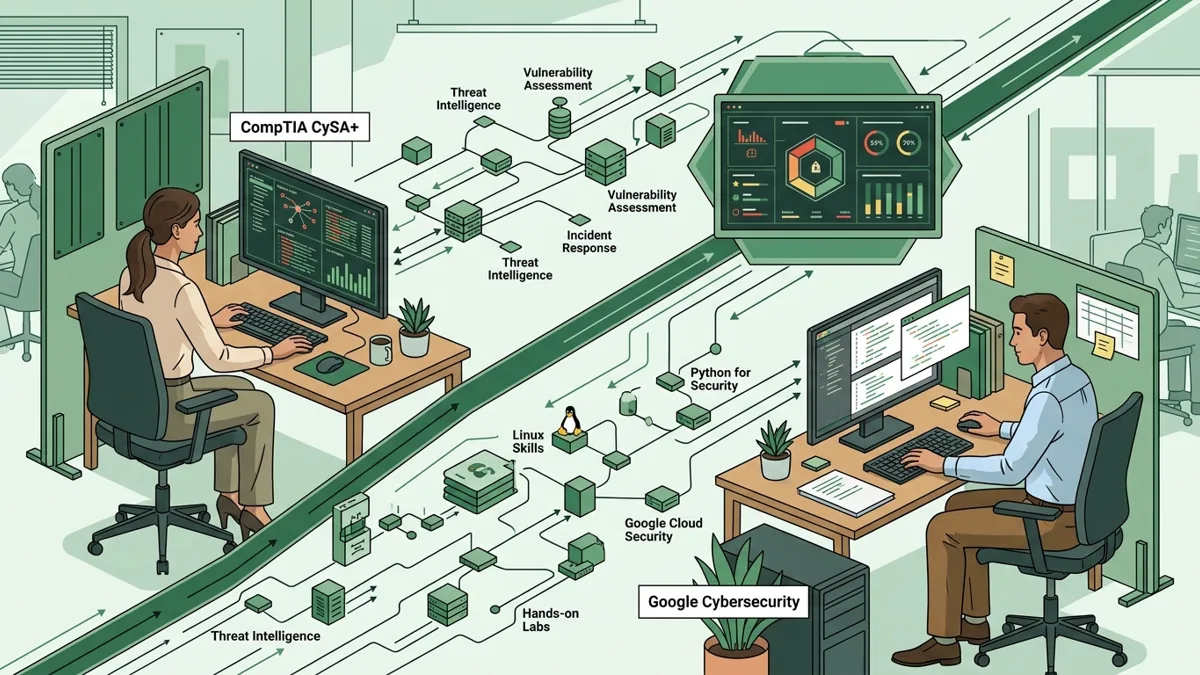
To understand which certificate is right for you, it is essential to look at what each program actually does. They are not direct competitors; rather, they are designed to be complementary steps on a security professional's career roadmap.
The Google Cybersecurity Professional Certificate is a self-paced, eight-course learning path hosted on Coursera. It is built specifically to take learners from zero knowledge to a foundational understanding of defensive security. Rather than preparing you for a high-stakes exam, its focus is on hands-on labs. You will use real tools like Wireshark, SQL, Linux, Python, and Splunk to analyze traffic and parse logs.
Conversely, the CompTIA CySA+ (CS0-003 / CS0-004) is a rigorous, proctored exam offered by CompTIA. It is vendor-neutral but intermediate-level, testing your ability to perform behavioral analytics, continuous security monitoring, and incident response. While the Google certificate teaches you how to write basic Python script, CySA+ expects you to already know how to analyze complex log data, prioritize vulnerabilities using the CISA Known Exploited Vulnerabilities (KEV) catalog, and map attacker behavior to the MITRE ATT&CK framework.
We previously detailed this step-by-step transition in our CompTIA Security+ vs Google Cybersecurity Certificate Comparison Guide. While Security+ acts as an entry-level bridge, CySA+ represents a distinct step up into mid-tier operations.
CompTIA CySA+ vs. Google Cybersecurity Certificate: At a Glance
| Feature | Google Cybersecurity Certificate | CompTIA CySA+ (CS0-004) |
|---|---|---|
| Skill Level | Beginner (No prerequisites) | Intermediate (Recommended 4 years of IT/Security experience) |
| Exam Format | No final proctored exam; graded quizzes and lab portfolios | Proctored exam; max 85 questions (multiple-choice & performance-based) |
| Primary Focus | Hands-on tool usage (Python, Splunk, SQL, Linux) | Behavioral analytics, threat intelligence, and vulnerability management |
| Time Investment | 3 to 6 months (~170 hours of study) | 1 to 3 months (depending on experience) |
| Pricing | $49 per month on Coursera (~$294 total for 6 months) | $425 to $439 per voucher |
| DoD 8140 Approved | No (but provides a 30% discount voucher for Security+) | Yes (CSSP Analyst, CSSP Incident Responder, IAT Level II) |
Quiztudy Analysis: Strategic Foresight on Exam Patterns
Our Take: The landscape of defensive security in 2026 prioritizes context over memorization. The updated CompTIA CySA+ CS0-004 objectives reflect this shift by heavily testing a candidate's ability to prioritize threat intelligence rather than just identifying a threat. In modern security operations, tier-1 triage is increasingly assisted by automated tools, meaning human analysts are expected to handle complex incident response and threat hunting right out of the gate.
If you prepare for the CySA+, you must expect performance-based questions (PBQs) that require you to analyze actual firewall logs, configure a security information and event management (SIEM) tool, or reconstruct an attack path. Memorizing port numbers is no longer enough. This is why active recall and scenario-based practice questions are critical to passing.
"According to the U.S. Bureau of Labor Statistics, employment for information security analysts is projected to grow 29 percent from 2024 to 2034, which is significantly faster than the average for all occupations."
Candidate Demographics & Sourcing
Who is actually taking these exams? According to recent data from Coursera's Learner Outcomes Reports and Pearson VUE's Value of IT Certification reports, we see a clear split in the demographics of those pursuing these programs.
The Google Cybersecurity Certificate attracts a massive crowd of career switchers, many of whom have no prior technical experience. In contrast, CySA+ candidates are overwhelmingly active IT professionals—such as systems administrators, help desk Tier 2 agents, or junior security analysts—who are sponsored by their employers to validate their skills.
Learner Backgrounds for defensive security credentials
Who Should Skip This Certificate
To ensure you don't waste time or money, here is when you should skip either credential:
Skip the Google Cybersecurity Certificate if:
- You already hold the CompTIA Security+ or CySA+: The Google curriculum will feel incredibly redundant, as it covers fundamental concepts you've already mastered.
- You are targeting government or defense sector roles: These positions specifically require DoD 8140/8570 compliance, which the Google certificate does not satisfy on its own.
- You have 2+ years of active IT administration experience: You are better off jumping straight into studying for the CompTIA Security+ or CySA+.
Skip the CompTIA CySA+ if:
- You do not understand basic networking or security principles: Without a foundational grasp of the OSI model, TCP/IP, and basic command-line navigation, CySA+ will be prohibitively difficult.
- You are pursuing an offensive security track: If your goal is penetration testing or red teaming, certifications like the CompTIA PenTest+ or OSCP are far more aligned with your career goals.
What the Certificate Won't Do
It is vital to maintain a realistic outlook when pursuing tech certifications. Earning either the Google Cybersecurity Certificate or the CompTIA CySA+ will not guarantee you a job.
The entry-level job market is highly competitive. Hiring managers routinely filter out candidates who only possess "paper credentials" without practical experience. A certificate proves you can pass a test or click through a guided lab; it does not prove you can handle a high-stress security incident under pressure.
To stand out, you must supplement your certifications with:
1. A GitHub Portfolio: Document your own scripts, such as a custom log parser written in Python or a custom bash script for automating vulnerability scans.
2. Home Lab Projects: Build a virtualized homelab using VirtualBox, set up a Security Onion instance, and capture/analyze your own network traffic using Wireshark.
3. Active Networking: Attend local BSides conferences, join security Discord communities, and write write-ups of TryHackMe or HackTheBox rooms on Medium or LinkedIn.
Career Outlook & Salary Expectations
The financial and professional upside of entering defensive security remains incredibly strong. According to the U.S. Bureau of Labor Statistics, the median annual wage for information security analysts is $124,910.
Depending on which path you choose, you can expect different entry points:
- Google Cybersecurity Certificate Path:
Typical Roles:* Tier 1 SOC Analyst, Junior Security Analyst, IT Support Specialist.
Salary Range:* Expect starting salaries between $58,000 and $70,000 depending on your local market and prior IT experience.
- CompTIA CySA+ Path:
Typical Roles:* Tier 2/3 SOC Analyst, Incident Responder, Vulnerability Analyst, Cybersecurity Engineer.
Salary Range:* Certified professionals typically command salaries between $75,000 and $110,000 due to the intermediate nature of the credential and the requirement for hands-on experience.
For more strategic guidance on security roles, see our Cybersecurity Certification Demand in 2026.
What This Means for Learners
If you decide to pursue the CySA+, you cannot rely on passive learning. Passively watching video courses or reading thousands of pages of study guides will result in poor retention.
At Quiztudy, we advocate for active recall and spaced repetition. When preparing for CySA+, practice analyzing raw logs (such as Apache, Windows Event Viewer, and Wireshark PCAPs) and immediately test yourself on what malicious activity is occurring. Research shows that testing your knowledge through practice exams that mimic real-world scenarios is the single most effective way to ensure long-term retention.
For more study strategy tips, check out our guide on Confidence-Based Marking in Practice Exams to learn how to measure your actual understanding before sitting for the real exam.
Frequently Asked Questions
1. Can I get a job with just the Google Cybersecurity Certificate?
While it is technically possible, it is highly unlikely without prior IT experience or an outstanding portfolio. The certificate is best used as a stepping stone to build skills, build a portfolio, and prepare for the CompTIA Security+ exam.
2. Is CompTIA CySA+ harder than Security+?
Yes, CySA+ is significantly harder than Security+. Security+ is a foundational exam focused on security terms, policies, and basic architecture. CySA+ is a technical, analytical exam that tests your ability to identify active threats, analyze logs, and configure security tools.
3. Does the Google Cybersecurity Certificate prepare you for the CySA+?
Not directly. The Google Certificate is designed to prepare you for the entry-level CompTIA Security+ exam. Passing the Google course provides a solid baseline, but you will need intermediate-level study materials and hands-on log analysis practice to pass the CySA+.
4. How much does it cost to maintain these certifications?
The Google Certificate has no maintenance fees once completed. The CompTIA CySA+ is valid for three years and requires 60 Continuing Education Units (CEUs) and a maintenance fee of $150 ($50/year) to keep it active, or you can renew it by passing a higher-level exam.
Ready to start building your security analyst career?
Practice the concepts the same way you will use them in real-world interviews and on the job. Get started with hands-on labs and foundational training by checking out the Google Cybersecurity Professional Certificate on Coursera.
Sources:
1. U.S. Bureau of Labor Statistics: Information Security Analysts Occupational Outlook
2. Coursera: Google Cybersecurity Professional Certificate Page
3. CompTIA Store: CompTIA CySA+ Certification Page
4. Pearson VUE: Value of IT Certification Report
5. Grow with Google: Employer Consortium Details
Google certifications (or AWS/Microsoft) are issued by their respective organizations, and Quiztudy is an independent practice platform.